

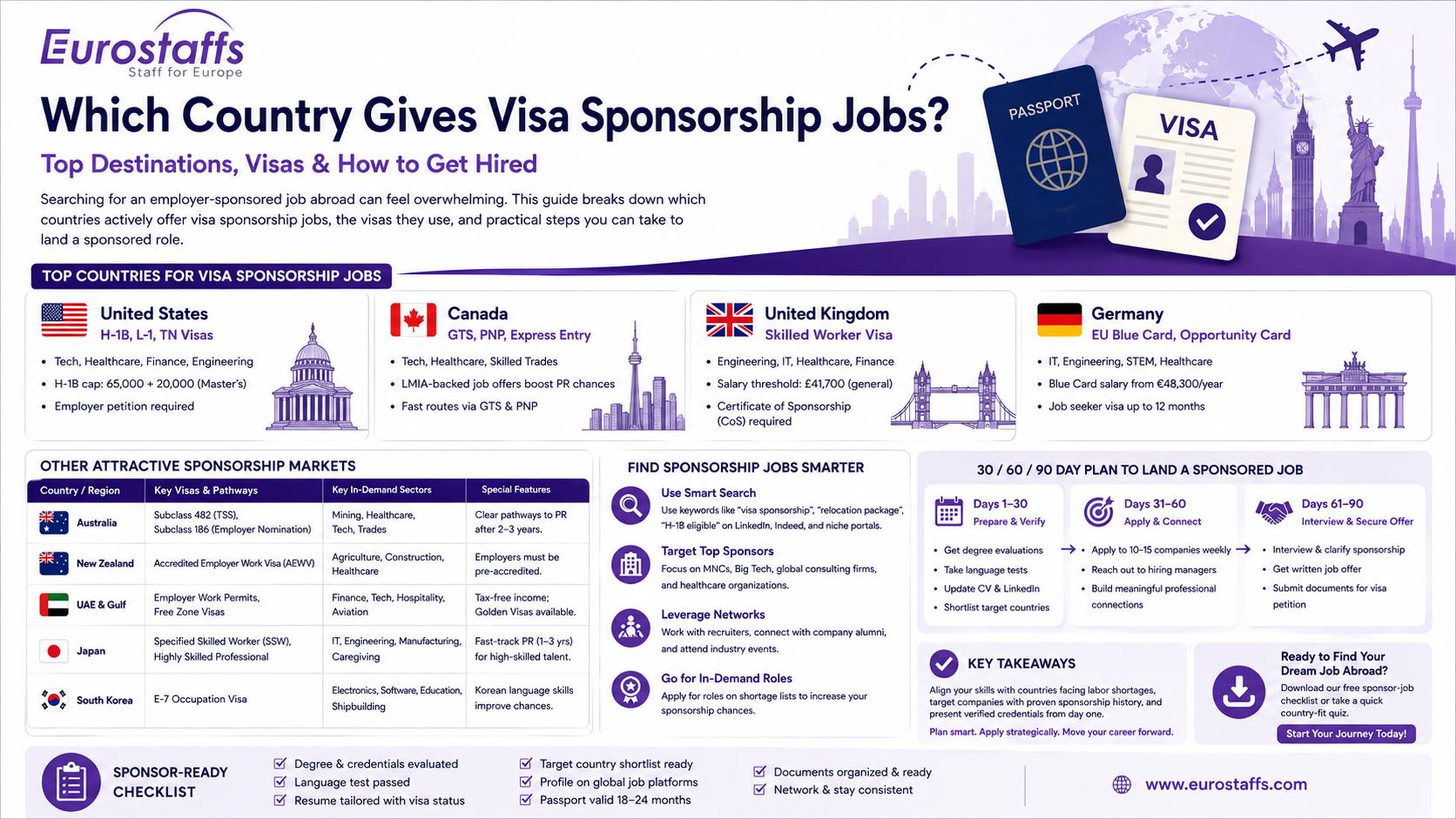
Which Country Gives Visa Sponsorship Jobs? Top Destinations, Visas & How to Get Hired
Searching for an employer-sponsored job abroad can feel overwhelming. Navigating different legal systems, understanding fluctuating salary thresholds, and finding employers willing to handle petition paperwork require clarity and a solid strategy.
This comprehensive guide breaks down which countries actively offer visa sponsorship jobs, how their visa systems operate, and the exact steps you can take to land a sponsored role.
1. Understanding Visa Sponsorship: What It Means and How It Works
a. Employer-Sponsored vs. Government-Sponsored Visas
Visa sponsorship means a foreign employer legally petitions a government to allow you to work in their country.
Employer-Sponsored Route: Your right to work and reside in the host country is tied directly to a specific employer who vouches for you and sponsors your visa petition.
Government-Sponsored / Self-Petitioned Route: Independent pathways (such as Canada’s Express Entry Federal Skilled Worker stream or Australia’s Independent Skilled visa) score you on age, education, and language skills without requiring a pre-existing job offer up front.
b. Common Sponsorship Models
Most countries regulate foreign work permits through three main models:
Employer Petition Model: The employer proves to immigration authorities that they need your specific skill set and file a petition on your behalf (e.g., U.S. H-1B, UK Certificate of Sponsorship).
Shortage Occupation & In-Demand Lists: Governments maintain official lists of occupations experiencing local labor shortages. Sponsoring workers in these categories often carries reduced salary thresholds or expedited processing.
Points & Skill-Based Thresholds: Systems that combine job offers with points evaluated against income level, degree recognition, and language fluency (e.g., German EU Blue Card, Canadian Provincial Nominations).
c. Eligibility Basics Employers Check
Before submitting a petition, employers verify whether you meet the host country's baseline immigration criteria:
Academic Equivalency: Degree credentials evaluated by recognized international bodies (e.g., WES in Canada, Anabin in Germany).
Professional Experience: Usually a minimum of 2 to 5 years of verified domain experience.
Language Proficiency: Formal test scores such as IELTS/PTE (English) or Goethe/TestDaF (German).
Labor Market Impact Tests: Requirements where employers must prove no local citizen or permanent resident was available to fill the role (e.g., U.S. PERM Labour Certification or Canadian LMIA).
d. Timelines, Employer Responsibilities, and Fee Structures
Timelines: Sponsoring a worker takes anywhere from 4 weeks (expedited tech visas) to 6–12 months (standard petitions involving labor market testing).
Employer Obligations: Sponsors must maintain tax compliance, pay legally mandated minimum salaries, and report structural changes in employment.
Fee Structure: In most Tier-1 economies (U.S., UK, Canada), laws explicitly prohibit employers from deducting sponsorship processing or legal filing fees from the candidate's salary.
2. Top Countries That Commonly Offer Visa Sponsorship Jobs
a. United States
The U.S. remains a top destination for specialized talent, though entry relies heavily on structured petition cycles.
H-1B Visa: Designed for specialty occupations requiring at least a Bachelor's degree. It operates under a strict annual cap of 65,000 standard visas plus 20,000 for advanced degree holders from U.S. institutions. Registrations open every March.
L-1 Visa: Intracompany transfers for managers/executives (L-1A) or specialized knowledge staff (L-1B) moving from an overseas branch to a U.S. office. It bypasses the annual H-1B lottery cap.
TN Visa: Exclusively for Canadian and Mexican citizens under the USMCA agreement across pre-approved professional categories.
Target Industries: Technology, Healthcare, Quantitative Finance, and Engineering.
b. Canada
Canada offers some of the most streamlined transitions from temporary work permits to Permanent Residency (PR).
Global Talent Stream (GTS): Accelerates 2-week work permit processing for high-growth tech, engineering, and digital roles.
Provincial Nominee Programs (PNP): Individual provinces sponsor candidates with specific job offers tailored to local economic shortages (e.g., Ontario Tech Draw, BC PNP).
Express Entry (Category-Based Draws): Grants extra points or direct invitations to foreign workers with validated job offers backed by a Labor Market Impact Assessment (LMIA).
c. United Kingdom
The UK relies heavily on foreign talent to fill structural gaps across sectors following major immigration restructuring.
Skilled Worker Visa: Requires a job offer from a Home Office-licensed sponsor. Sponsors assign a Certificate of Sponsorship (CoS) to validate your employment.
Salary Thresholds: The baseline general threshold is £41,700 per year or 100% of the standard "going rate" for the specific occupation code, whichever is higher. Reduced thresholds apply for STEM PhD holders, new entrants (under 26/recent graduates), and roles on the Immigration Salary List (ISL).
Health and Care Worker Visa: A specialized stream for healthcare professionals offering lower visa fees and reduced salary baselines starting around £31,300.
d. Germany
Germany has actively lowered barriers for non-EU skilled professionals to combat workforce shortages.
EU Blue Card: Fast-track route for university graduates and IT specialists. Requires a job offer with a minimum gross salary of roughly €48,300/year (or a reduced threshold around €43,760/year for shortage occupations like STEM, medicine, and IT). IT professionals can qualify based on 3+ years of relevant experience even without a formal degree.
Opportunity Card (Chancenkarte): A points-based job seeker visa allowing qualified candidates to enter Germany for up to 12 months to search for employment while working part-time (up to 20 hours/week). Points are awarded for age, language skills (German/English), and professional qualifications.
3. Other Emerging & Regional Sponsorship Markets
4. Practical Strategies to Find Employer-Sponsored Jobs
a. Master Job Board Filters and Search Strings
Avoid standard broad job searches. Use exact keyword strings on platforms like LinkedIn, Indeed, Seek (Australia), and StepStone (Germany):
"visa sponsorship provided"
"relocation package included"
"H-1B eligible" OR "Certificate of Sponsorship"
"EU Blue Card candidate"
Use niche job portals focused specifically on global mobility:
Relocate.me (Tech jobs with relocation)
Otta (High-growth tech startups offering sponsorship)
Jobbatical (International talent mobility roles)
b. Target High-Volume Visa Sponsors
Multinational corporations (MNCs), Big Tech, major audit firms, and healthcare systems maintain existing legal infrastructure for global hiring:
Technology: Amazon, Google, Microsoft, SAP, ASML.
Consulting & Finance: Deloitte, PwC, EY, KPMG, HSBC, Bloomberg.
Healthcare: NHS Trusts (UK), public regional health boards (Canada/Australia).
c. Leverage Specialized Agencies and Professional Networking
Connect with global talent acquisition partners who specialize in overseas recruitment.
Reach out directly to company alumni on LinkedIn who moved from your country to your target destination.
Ask specifically: "Did your employer facilitate your work permit application?"
d. Position Yourself for Shortage Occupations
Aligning your application with a country's official skill shortage list (e.g., Australia's PMSOL, UK's Immigration Salary List) significantly increases your chances, as labor market test requirements are often relaxed for these roles.
5. How to Make Your Application Sponsor-Ready
a. Highlight High-Value Certifications & Metrics
Sponsoring employers must justify why they chose an overseas candidate over local applicants. Your CV must prove exceptional capability:
Quantify impact (e.g., "Scaled database infrastructure handling 2M daily transactions, reducing latency by 40%").
Highlight internationally recognized credentials (AWS Certified Solutions Architect, PMP, ACCA, NCLEX-RN).
b. Format Your Resume and Cover Letter for Overseas Hiring
Add a dedicated Visa & Relocation Status block right under your contact header:
Work Authorization Status: Requiring Visa Sponsorship (EU Blue Card Eligible / H-1B Cap-Subject)
Relocation Availability: Ready to relocate within 60–90 days of visa issuance.
c. Prepare for Sponsorship-Focused Interview Questions
Be direct and knowledgeable when candidates are asked about work authorization:
Employer Question: "Do you have the right to work in our country?"
Optimal Response: "I require visa sponsorship, but I meet all criteria for the [Visa Name, e.g., UK Skilled Worker Visa / EU Blue Card]. My credentials are fully evaluated, and I am prepared to assist with the administrative process to ensure a smooth transition."
d. Assemble Your Application Document Portfolio
Prepare a digital repository containing:
Official degree certificates and transcripts.
Certified credential evaluation reports (WES, Anabin, UK ENIC).
Language test certificates (IELTS General/Academic, Goethe-Zertifikat).
Reference letters on official company letterheads confirming job titles, duties, and employment dates.
6. Legal, Timeline, and Cost Considerations
a. Processing Windows and Quota Deadlines
Fixed-Window Visas: The U.S. H-1B lottery closes in late March for employment starting October 1st of the same year.
Rolling-Basis Visas: UK Skilled Worker visas, Canadian GTS, and German Blue Cards are processed year-round, typically taking 3 to 8 weeks post-petition.
b. Fee Allocation: Employer vs. Candidate
In most standard setups:
Employer Pays: Sponsor license fees, legal petition costs, and labor market testing expenses.
Candidate Pays: Personal visa stamp application fees, English/language tests, credential evaluations, and passport processing (unless a relocation package covers them).
c. Work Permit Restrictions & Pathways to Permanent Residency
Tied Permits: Most sponsored work visas bind you to a single employer. If you change jobs, your new employer must transfer your sponsorship petition before you can work for them.
Dependents: Tier-1 routes generally permit spouses to work and children to attend local public schools.
Permanent Residence (PR):
UK: Eligible for Indefinite Leave to Remain (ILR) after 5 years.
Germany: Eligible for PR in 27 months (reduced to 21 months with B1 German) under an EU Blue Card.
Canada: Eligible for PR via Canadian Experience Class (CEC) after 1 year of skilled work.
7. Actionable Roadmap & Real-World Examples
30 / 60 / 90-Day Execution Plan
Days 1–30 (Audit, Verification & Document Prep):
Order foreign degree evaluations (WES/UK ENIC/Anabin).
Take required language proficiency tests (IELTS/PTE/Goethe).
Restructure your resume and LinkedIn profile to target specific countries and highlight visa eligibility.
Days 31–60 (Targeted Applications & Network Outreach):
Apply to 10–15 verified sponsor companies weekly on niche sites (Relocate.me, LinkedIn filtered).
Connect directly with global talent leads and hiring managers.
Engage in informational interviews with professionals who successfully secured relocation visas in your field.
Days 61–90 (Interviews, Negotiations & Visa Filing):
Interview with target companies and clarify work authorization expectations early.
Secure written employment contracts that explicitly state sponsorship commitments.
Submit personal paperwork to support your employer's visa petition submission.
Case Studies
Case Study 1: Tech Professional Securing U.S. / EU Sponsorship
Candidate: Senior DevOps Engineer based in Dhaka, Bangladesh.
Strategy: Focused on German tech scale-ups offering EU Blue Card sponsorship due to zero annual caps.
Execution: Optimized LinkedIn profile with keywords like "Kubernetes", "AWS", "CI/CD". Applied via Otta. Received a job offer from a Berlin tech firm at €72,000/year.
Outcome: With a university degree verified via Anabin, the candidate received an EU Blue Card approval within 4 weeks, bypassing lengthy labor market tests.
Case Study 2: Healthcare Worker Gaining Canadian Sponsorship
Candidate: Registered Nurse with 4 years of clinical experience.
Strategy: Targeted Canadian provinces with critical healthcare shortages via Provincial Nominee Programs (PNP).
Execution: Completed NNAS credential assessment, passed IELTS Academic, and applied to regional health authorities in Nova Scotia.
Outcome: Received a conditional job offer backed by an LMIA, leading to a provincial nomination and expedited PR processing under Express Entry.
Outreach Script Template for Employers
Subject: Application: [Job Title] - [Your Name] | Experienced [Your Profession]
Dear [Hiring Manager / Recruiter Name],
I recently reviewed the [Job Title] opening at [Company Name] and wanted to share my strong interest in joining your team.
With over [X] years of experience in [Key Industry/Skill], I have led projects resulting in [Brief Notable Achievement, e.g., 35% efficiency increase].
I am based in [Current Country] and am actively seeking roles eligible for [Visa Name, e.g., UK Skilled Worker / EU Blue Card] sponsorship. My credentials and language tests are fully prepared, allowing for a fast petition process.
I would welcome the opportunity to discuss how my expertise aligns with your team's goals. My resume is attached for your review.
Best regards,
[Your Name]
[LinkedIn Profile Link] | [Portfolio Link]
Summary Checklist for Applicants
Academic credentials evaluated by international evaluation services (WES, ENIC, Anabin).
Language proficiency exam passed with top-tier scores.
Resume customized with explicit work authorization and relocation statements.
Target country shortlist finalized based on personal qualifications and shortage lists.
Profile created on specialized international recruitment platforms (Relocate.me, LinkedIn, Otta).
Passport valid for at least 18–24 months beyond the intended start date.
Key Takeaways
Securing an employer-sponsored job requires aligning your skills with countries that have active labor shortages, targeting companies with established sponsorship programs, and presenting fully verified credentials from day one. By focusing on streamlined routes—such as the German EU Blue Card, Canada's Global Talent Stream, or the UK Skilled Worker visa—you can successfully transition your career to an international market.




 Arabic
 Chinese
 French
 Russian
 Spanish