

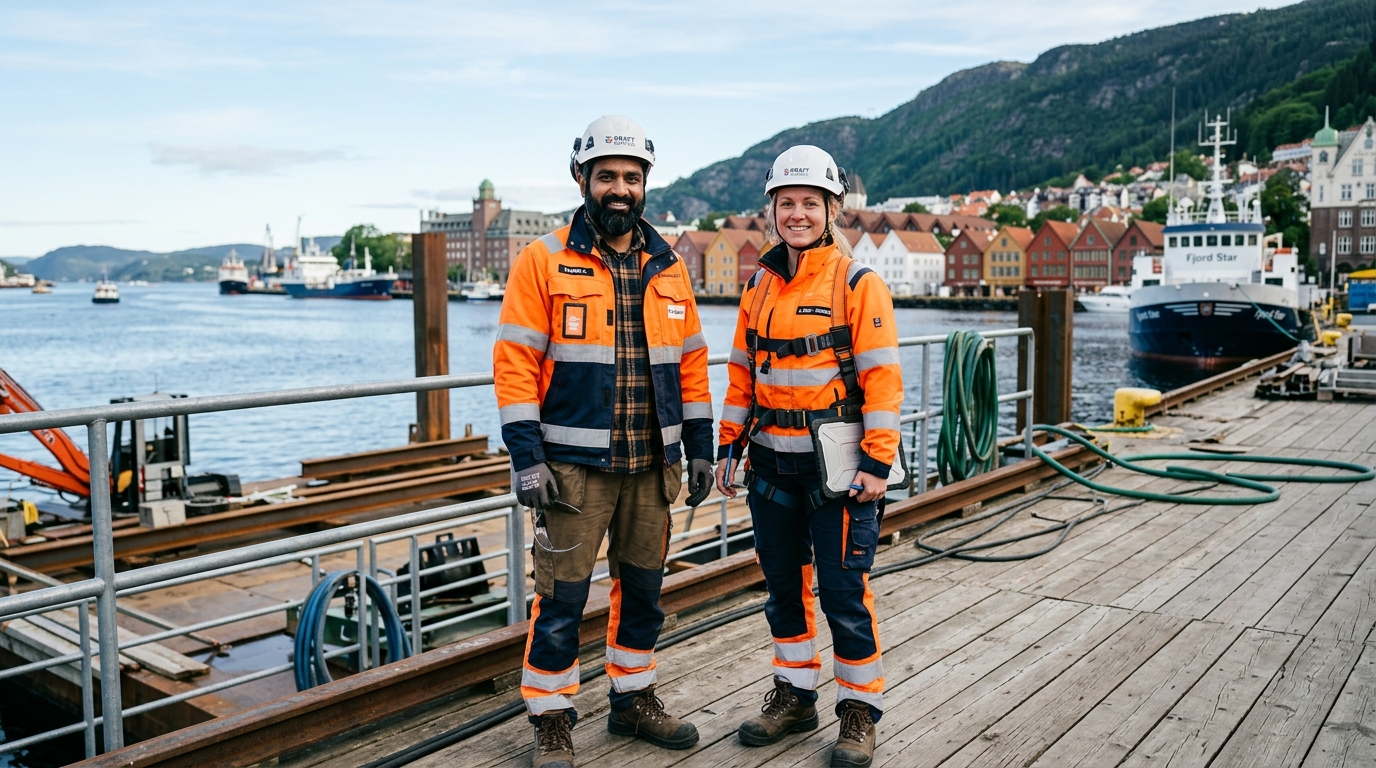
Across Europe's industrial heartlands, factory floors and civil construction sites are running below capacity—not from a lack of contracts, but from a lack of qualified hands. Whether it's a precision metal fabrication plant in Baden-Württemberg, a commercial HVAC contractor in Dublin, or an automated logistics terminal in Rotterdam, open technical roles routinely sit unfilled for four to six months. According to European Commission and Cedefop workforce projections, the EU faces a structural shortfall exceeding 1.2 million skilled tradespeople, technicians, and machine operators. For industrial leaders, structured skilled trades staffing in Europe has become an operational necessity rather than an optional hiring channel.
1. Introduction to the Market
Every idle CNC spindle or delayed electrical installation hits a manufacturer's bottom line immediately. Surveys by the German Chamber of Industry and Commerce (DIHK) indicate that over 50% of industrial enterprises identify skilled labor gaps as a direct threat to order fulfillment and business expansion. Local labor exchanges increasingly circulate the same limited pool of aging technicians, pushing overtime costs higher while delaying delivery milestones.
To regain control over production schedules, manufacturers and contractors are establishing direct cross-border talent pipelines. Turnkey international recruitment bridges the gap between European industrial demand and certified technical talent pools in South Asia. When backed by hands-on workshop testing and strict immigration compliance, cross-border hiring delivers reliable, safety-certified technicians at predictable unit costs.
2. Market Overview: Why Industrial & Skilled Trades Staffing Is Expanding Rapidly Across Europe
Global & European Industrial Trends
Two powerful forces are reshaping European technical employment: rapid retirement of veteran tradesmen and accelerated infrastructure investment. Across Western Europe, vocational apprenticeship enrollments have failed to keep pace with industrial demand for more than a decade. At the same time, Europe's green energy transition—solar grid builds, heat pump retrofits, EV battery plants, and rail modernization—requires hundreds of thousands of certified electricians, pipefitters, and structural welders.
Meanwhile, technical training institutes across Bangladesh and South Asia graduate tens of thousands of diploma engineers, certified welders, CNC machinists, and heavy equipment mechanics each year. Many already possess years of Gulf or Middle Eastern mega-project experience working under strict international safety regimes. Connecting these verified technicians with European employers resolves two problems at once: eliminating European production bottlenecks while offering skilled workers stable, long-term careers.
Key European Regions Facing Critical Technical Deficits
Technical labor shortages hit specific industrial corridors harder than others, depending on local manufacturing density and infrastructure spending:
- Germany & Austria: Europe's manufacturing core faces acute shortages in CNC machining, mechatronics, industrial electrical installation, and commercial plumbing. Under Germany's modernized Skilled Immigration Act (Fachkräfteeinwanderungsgesetz), employers can now bring in experienced vocational specialists with two years of recognized training and a compliant job offer.
- The Netherlands & Belgium: High-density maritime, petrochemical, and automated warehousing hubs in Rotterdam and Antwerp constantly seek certified TIG/MIG welders, industrial maintenance mechanics, and reach-truck technicians.
- The United Kingdom & Ireland: Post-Brexit labor shifts left severe gaps across commercial construction, HVAC installation, and civil engineering. Ireland's Critical Skills and General Employment Permit frameworks actively support foreign engineering technicians and site supervisors.
- Poland, Czech Republic & Nordics: Central Europe's booming automotive and appliance assembly plants face local unemployment under 3%, creating steady demand for assembly technicians, structural fabricators, and heavy diesel mechanics, while Norway and Sweden recruit heavily for marine, energy, and cold-weather construction trades.
3. Growth Opportunities for Manufacturers and Contractors
Companies that build a repeatable international trades pipeline gain an immediate edge when bidding on major commercial contracts. Instead of turning down multi-million-euro tenders due to uncertain headcount, contractors can lock in guaranteed technician availability before signing project schedules.
Retention economics tell an even stronger story. Domestic temporary staffing agencies in Europe frequently charge steep hourly markups while experiencing 30% to 40% annual turnover among contract tradesmen. By contrast, internationally sponsored technicians tied to stable, direct employment contracts demonstrate an 88% retention rate past 24 months, giving plant managers consistent shift stability and lower retraining expenses.
Flexibility and Cost Control in Industrial Workforce Deployment
Industrial hiring needs fluctuate with order books, seasonal construction windows, and plant expansions. EuroStaffs structures flexible deployment models so operations directors can match hiring commitments directly to production forecasts:
- Direct Permanent Trade Hiring: Full-cycle sourcing, practical workshop vetting, and visa sponsorship for core plant technicians, CNC programmers, and maintenance leads.
- Batch Project Deployment: Coordinated mobilization of 15 to 80+ certified welders, pipefitters, or electrical installers for multi-year infrastructure, shipyard, or factory commissioning projects.
- Fixed-Term Contract Staffing: Structured 12-to-36-month technical deployments aligned with specific commercial build schedules and local wage laws.
- Supervisory & Foreman Placement: Bilingual technical supervisors and quality inspectors capable of bridging communication between site engineers and international trade crews.
4. Satisfying Operational Demands in European Manufacturing & Construction
Adapting to Automation, Green Energy, and Modern Engineering Standards
Modern European factories do not run on outdated manual tools. CNC lathes, robotic welding cells, automated warehouse conveyors, and smart building HVAC controls demand technicians who can read CAD blueprints, calibrate sensors, and follow strict lockout-tagout procedures. EuroStaffs tests candidates directly against these contemporary requirements rather than accepting generic trade certificates at face value.
Scalability for Large-Scale Plant & Infrastructure Projects
When a tier-1 supplier wins a new production line contract or a civil contractor breaks ground on a logistics park, scaling from five technicians to forty cannot take a year. Our centralized testing yards and pre-screened talent pool allow European operations to expand technical headcount in structured waves without sacrificing vetting rigor.
Maintaining Consistent Technical Quality at Scale
Bringing in underqualified workers creates scrap, rework, and workplace safety hazards. To eliminate technical surprises on day one, EuroStaffs enforces a practical workshop testing gateway. Welders execute live 3G/4G/6G joints evaluated against ISO 9606 and DVS benchmarks; machinists read engineering tolerances and set tool offsets; electricians wire three-phase control panels under timed supervision. Every test is video-recorded for your plant engineer to inspect before you issue a single contract.
Custom Workforce Solutions for Strict European Safety Standards
European occupational safety regulations—whether German BGV/DGUV rules, Dutch VCA certifications, or UK CSCS site standards—are non-negotiable. We customize pre-departure safety orientations so arriving workers already understand PPE rules, hazard signage, tool inspection logs, and incident reporting before stepping onto your shop floor.
5. Long-Term Reliability and Return on Investment
Upfront international recruitment costs—trade testing, document legalization, visa processing, and airfare—must justify themselves against real plant economics. Consider a mid-sized metal fabrication plant running six unfilled welding and CNC stations. At a conservative €600 per station per shift in lost value-added output, a 90-day hiring delay costs over €320,000 in unrealized revenue, not counting late-delivery penalties.
When deployed through EuroStaffs, those upfront mobilization expenses typically pay back within 90 to 120 days of normal shift output. With multi-year employee retention above 85% and zero recurring domestic temp-agency markups, manufacturers stabilize unit labor costs and protect long-term operating margins.
"One uncertified welder on a pressure vessel line can cost more in X-ray rework than an entire year's recruitment budget. Video-verified workshop testing before a worker ever boards a plane changes the math completely." — European Plant Operations Director
6. Why We Recommend EuroStaffs for Turnkey Skilled Trades Staffing Services
European manufacturers and contractors need a recruitment partner that understands shop-floor reality, not just HR paperwork. Operating from our registered recruitment headquarters in Dhaka, Bangladesh, with direct European employer coordination, EuroStaffs has built a specialized industrial talent pipeline connecting vetted South Asian tradesmen with factories, shipyards, and construction firms across Europe.
| EUROSTAFFS INDUSTRIAL STAFFING CORE ADVANTAGES | |
|---|---|
| Service Pillar | Operational Value Delivered |
| 1. A-Z Trade Recruitment | End-to-end execution from technical job profiling and live workshop testing to visa filing and airport arrival. |
| 2. Industrial Trade Verticals | Specialized divisions for Welding, CNC Machining, Industrial Electrical, HVAC, Heavy Mechanics, and Logistics. |
| 3. Visa & Equivalence Support | In-house immigration specialists managing apostilles, ZAB/IHK recognition, work permits, and VFS processing. |
| 4. Workforce & Wage Advisory | Guidance on local collective bargaining wages, housing compliance, safety orientation, and retention planning. |
1. End-to-End "A-Z" Turnkey Trade Recruitment
Plant managers do not have time to verify foreign technical diplomas or chase embassy appointments. EuroStaffs manages the complete operational sequence:
- Technical Specification Mapping: Translating your exact machine models, welding codes, or electrical schematics into clear testing criteria.
- Supervised Workshop Assessments: Live practical exams in Dhaka trade centers recorded on video for your engineering sign-off.
- Credential Legalization: Managing notarization, apostille stamping, and formal vocational equivalence submissions.
- Consular & Travel Logistics: Handling medical clearances, police checks, VFS biometrics, and group flight coordination.
2. Specialized Industrial Trade Verticals
We maintain active, pre-screened candidate pools across high-demand European technical trades:
- Metal Fabrication & Welding: Certified 3G/4G/6G TIG, MIG, MAG, and arc welders, pipefitters, and structural steel fabricators.
- Precision Machining & Automation: CNC milling and lathe operators (Fanuc, Siemens, Heidenhain controls), toolmakers, and PLC maintenance technicians.
- Electrical & MEP Contracting: Industrial panel builders, commercial electricians, HVAC installers, and solar/heat-pump technicians.
- Construction & Heavy Plant: Formwork carpenters, rebar fixers, tower crane operators, and heavy diesel equipment mechanics.
- Logistics & Fleet Operations: Reach-truck operators, automated warehouse technicians, and commercial fleet mechanics.
3. Complete Legal, Visa, and Equivalence Support
Every destination country enforces strict technical immigration rules. Whether filing under Germany's Skilled Immigration Act, securing UK Certificates of Sponsorship, or assembling Polish Type A work permits, our legal team audits every dossier twice prior to embassy submission—sustaining a first-time visa approval rate above 98%.
4. Strategic Workforce & Wage Consulting
We help employers structure compliant compensation packages aligned with local collective bargaining agreements (Tarifverträge) and statutory minimum thresholds. Just as importantly, EuroStaffs strictly enforces International Labour Organization (ILO) fair recruitment rules—candidates never pay illegal placement fees, ensuring workers arrive focused, debt-free, and loyal to your operation.
7. The EuroStaffs Industrial Recruitment Model
System Overview
Our industrial staffing model pairs a database of over 25,000 pre-screened technical profiles with physical trade-testing workshops. Once your requisition arrives, we shortlist candidates with verified prior project experience, run live practical bench tests, verify English or German communication readiness, and present complete video dossiers to your engineering managers.
| SKILLED TRADES VETTING & DEPLOYMENT PIPELINE | ||
|---|---|---|
| Stage | Workflow Phase | Technical & Compliance Checkpoint |
| 01 | Technical Scoping | Define machine controls, welding codes, safety certifications, and compliant European wage bands. |
| 02 | Candidate Screening | Match against verified technical profiles with documented industrial or Gulf project experience. |
| 03 | Live Workshop Test | Supervised physical trade examination recorded on HD video against ISO / DVS standards. |
| 04 | Language & Safety Check | Operational English or German assessment plus European PPE and shop-floor safety verification. |
| 05 | Client Technical Panel | Your plant manager reviews test videos, conducts live interviews, and approves job offers. |
| 06 | Visa & Legal Filing | Apostille legalization, work permit filing, biometric scheduling, and embassy clearance. |
| 07 | Site Mobilization | Flight arrival, municipal registration, tax ID setup, safety induction, and 90-day follow-up. |
Deployment Capacity and Timeline Breakdown
Accurate lead-time planning lets production planners align shift rosters before workers arrive:
- Trade Testing Capacity: Up to 250 skilled tradespeople evaluated per week across welding, machining, electrical, and mechanical bays.
- Shortlisting Speed: 10 to 14 working days to deliver video-verified candidate dossiers.
- Country Visa Timelines:
- United Kingdom (Skilled Worker): 3 to 6 weeks post-Certificate of Sponsorship.
- Germany (Skilled Worker / FEG): 6 to 12 weeks including local authority pre-approval.
- Netherlands & Ireland: 8 to 14 weeks depending on permit stream.
- Poland & Central Europe: 10 to 16 weeks based on regional voivodeship queues.
- Workforce Retention: 88% continuous employment past month 24.
Investment and Budget Considerations
Rather than unpredictable percentage headhunter markups, EuroStaffs operates on transparent, milestone-based project pricing linked directly to verified deliverables: shortlist approval, visa issuance, and physical site arrival. Employers know exact mobilization costs upfront, with zero hidden agency fees.
8. Quality Control, Safety Compliance, and Risk Management
Compliance Protocols and Risk Management
Using unaccredited labor brokers exposes European manufacturers to severe legal penalties, sponsor license revocation, and workplace safety failures. EuroStaffs protects your enterprise through four non-negotiable risk controls:
EuroStaffs Industrial Risk Mitigation Standards:
- Zero-Fee Ethical Recruitment: Full compliance with ILO Fair Recruitment Principles—workers never carry illicit debt, eliminating absconding risks.
- Primary-Source Credential Checks: Direct verification of trade school diplomas, prior employer references, and national police clearance certificates.
- Pre-Departure Safety Conditioning: Mandatory training in European PPE standards, crane/forklift signals, and hazard communication.
- GDPR-Compliant Data Handling: Encrypted transfer and storage of all employee passports, medical records, and corporate contracts.
9. Turnkey Solutions for Industrial Workforce Deployment
Complete Turnkey Service Package
Getting a visa approved is only half the deployment challenge. Making sure technicians settle smoothly into local housing and pass their first week on the factory floor is where long-term retention is won.
| TURNKEY INDUSTRIAL RELOCATION & ONBOARDING | |
|---|---|
| Pre-Departure Induction | Job-specific technical terminology, European shift punctuality norms, and industrial safety rules. |
| Group Travel & Arrival | Coordinated flight itineraries, airport pickup, and direct transfer to employer-arranged or pre-vetted housing. |
| Civic & Banking Setup | Step-by-step guidance for municipal registration (e.g., German Anmeldung), tax IDs, health insurance, and payroll accounts. |
| 90-Day Replacement Guarantee | Dedicated bilingual check-ins during probation, backed by a fee-free replacement guarantee within 90 days. |
Onboarding Support, Settlement, and 90-Day Replacement Guarantees
During the critical first 90 days, our bilingual coordinators check in regularly with both your shop-floor supervisor and the deployed crew to resolve housing, commuting, or shift communication questions early. If any candidate fails to meet technical or conduct expectations during the 90-day probationary window, EuroStaffs sources and processes a qualified replacement without charging an additional agency fee.
10. Success Cases Across European Manufacturing & Construction
Industrial operators across Europe have resolved acute skilled trade bottlenecks through EuroStaffs:
- Precision Metal Fabrication Plant (Bavaria, Germany): Facing a chronic shortage of CNC milling operators and certified TIG welders, a Tier-2 automotive supplier partnered with EuroStaffs to recruit 24 verified technicians. Following video-recorded workshop testing in Dhaka and fast-track FEG visa filing, all 24 workers arrived within 14 weeks—lifting monthly plant throughput by 28% and cutting overtime costs by €38,000 per month.
- Maritime & Petrochemical Contractor (Rotterdam, Netherlands): Ahead of a major port maintenance turnaround, a Dutch engineering contractor mobilized 32 certified pipefitters and structural welders through EuroStaffs. Every technician passed VCA safety induction on the first attempt, completing the shutdown project four days ahead of schedule.
- Commercial MEP & HVAC Contractor (Dublin, Ireland): Unable to source licensed industrial electricians locally, an Irish building services firm recruited 18 certified electricians and HVAC technicians via Ireland's employment permit stream, keeping two commercial hospital builds on schedule without delay penalties.
- Automated Logistics & Assembly Hub (Wrocław, Poland): An industrial equipment manufacturer expanding its assembly line deployed 35 electromechanical assemblers and reach-truck operators via EuroStaffs, achieving 94% retention past month twelve.
11. Investment & Business Opportunity: Cross-Border Skilled Trades Acquisition
Value Proposition for Plant Directors & Contractors
Building a direct international recruitment pipeline insulates your business from local labor scarcity. Instead of turning away profitable industrial contracts or overpaying short-term temp agencies, your plant secures committed, tested technicians who grow with your operations.
Operational Gains for Operations & HR Managers
For HR directors and production heads, EuroStaffs turns unpredictable cross-border hiring into a standardized engineering workflow. You review real workshop performance on video, interview pre-screened finalists, and leave credential checks, embassies, and flight coordination to a single accountable partner.
12. Frequently Asked Questions (FAQ)
Below are direct answers to key operational questions from European plant managers and industrial contractors:
How does EuroStaffs verify hands-on skills for welders, CNC machinists, and electricians before departure?
We never rely solely on paper diplomas. Candidates complete practical, timed workshop examinations in our accredited trade testing centers under the supervision of certified master tradesmen. Welders perform TIG, MIG, and MAG joints inspected against ISO 9606 / DVS standards; CNC operators run live G-code setups; and industrial electricians complete full schematic wiring checks. Every test is recorded on high-definition video for your engineering team to review.
What is the typical timeline to deploy a batch of 10 to 30 skilled technicians to Germany, Poland, or the Netherlands?
From finalized job specifications to on-site arrival, deployment generally takes between 8 and 16 weeks. Technical screening and video-recorded workshop testing take 10 to 14 working days. Consular visa and work permit timelines vary by country: UK Skilled Worker visas typically process in 3 to 6 weeks, German Skilled Worker permits take 6 to 12 weeks, and Polish or Dutch permits range from 8 to 14 weeks.
Do European employers have to manage foreign credential recognition and embassy paperwork themselves?
No. EuroStaffs manages the entire administrative chain, including document notarization, apostille legalization, IHK/ZAB qualification equivalence filings where required, biometric VFS scheduling, and pre-departure safety orientation. Employers simply provide compliant local employment contracts matching national collective wage standards.
13. Final Call to Action for European Manufacturers and Contractors
Skilled trade shortages across Europe are structural, not temporary. Manufacturers and contractors that establish reliable, ethical international hiring pipelines today will capture the contracts their competitors cannot staff tomorrow.
Start Building Your Verified Technical Workforce Today:
- Email your technical staffing specifications directly to [email protected]
- Post your skilled trade requisitions on the EuroStaffs European Jobs & Employer Portal
- Request sample trade-test evaluation videos and schedule a workforce planning call with our Dhaka and European industrial recruitment coordinators.
Partner with EuroStaffs Group—delivering tested, visa-ready skilled tradespeople directly to European industry.
Written by the EuroStaffs Industrial & Global Workforce Advisory Board
The EuroStaffs Industrial & Global Workforce Advisory Board brings together European technical recruitment directors, accredited trade-testing engineers, and EU/UK immigration specialists with over 18 years of combined experience in industrial labor mobility. All labor market figures and regulatory workflows are verified against current European Commission, Cedefop, DIHK, and national immigration publications.


 Arabic
 Chinese
 French
 Russian
 Spanish