

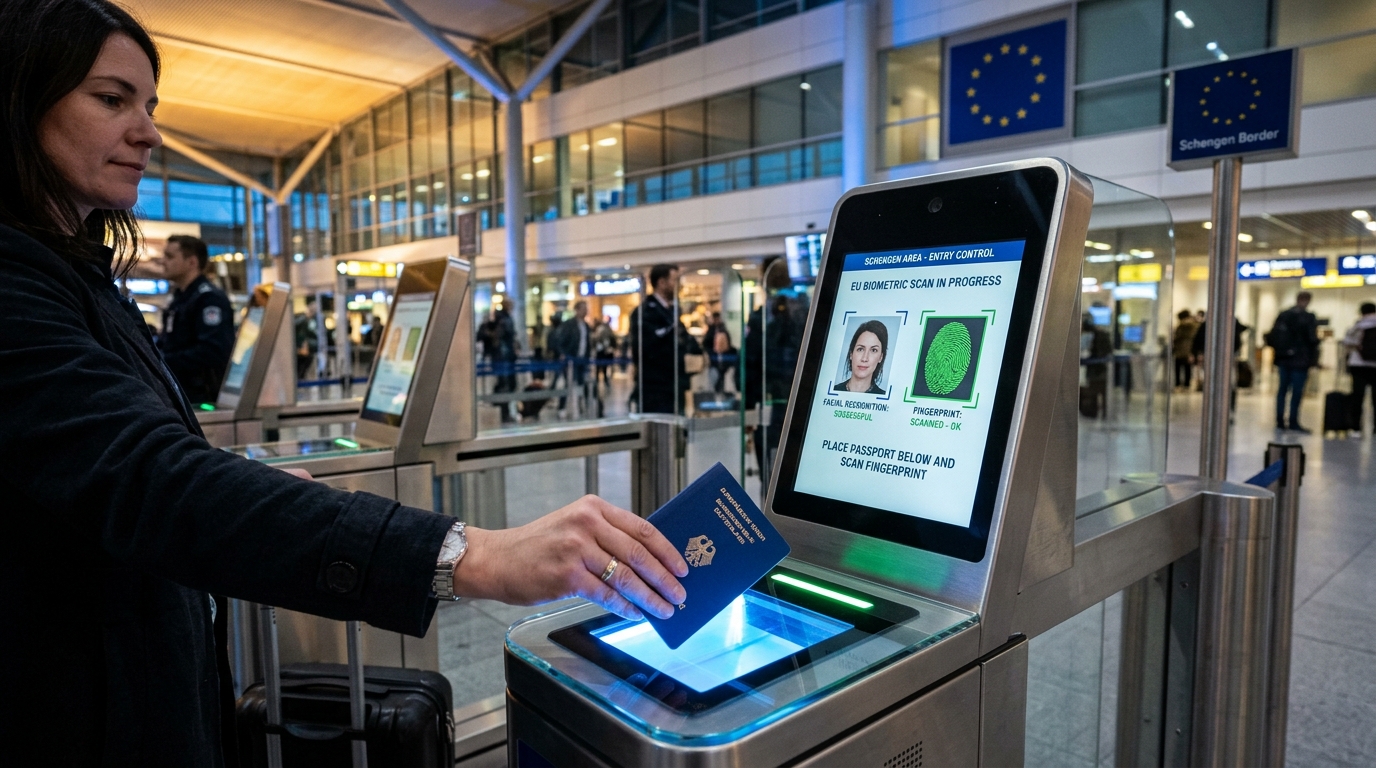
International travel and immigration across Europe have entered a historic digital era. The European Union has officially implemented its landmark Entry/Exit System (EES) across all external border checkpoints of the 29 European Schengen member states. Under this modernized regulatory architecture, the traditional practice of border guards manually stamping physical passport pages with ink stamps has been permanently eliminated. In its place stands an automated, centralized digital infrastructure that captures biometric facial images, scans fingerprints, and logs the precise entry and exit timestamps of third-country travelers.
For Bangladeshi citizens — including business travelers, tourists, short-term trainees, and skilled workers preparing for overseas deployment — the rollout of the EES introduces substantial procedural shifts, strict compliance obligations, and heightened scrutiny. In Dhaka, Sylhet, and Chittagong, widespread rumors and unverified social media claims have generated immense confusion: Does the EES replace the need for a Schengen sticker visa? Will Bangladeshi workers holding employment permits face entry issues at European airports? How does the automated 90/180-day overstay counter function?
This authoritative EuroStaffs advisory handbook provides exhaustive, statutory clarity on the European Union's Entry/Exit System. We dissect the legislative foundations under Regulation (EU) 2017/2226, detail the exact airport biometric screening procedures, clarify critical exemptions for long-stay (Type D) work and student permit holders, outline automated overstay penalties, and provide actionable guidance for Bangladeshi applicants navigating legitimate European career and migration pathways in 2026.
Table of Contents: EU Schengen EES Biometric Rules & Bangladesh Guide
- 1. What is the EU Entry/Exit System (EES)? Legal Foundation & 29 Participating Nations
- 2. The End of Manual Passport Stamps: 100% Centralized Electronic Logging
- 3. Biometric Border Protocol: Facial Recognition & 4-Fingerprint Digital Capturing
- 4. Automated 90/180-Day Rule Calculation & Instant Overstay Alert Triggers
- 5. Critical Classification: Who Must Register in EES vs. Who is Legally Exempt (Type D Permits)
- 6. Step-by-Step Airport Workflow: From Dhaka (DAC) to Schengen Port of Entry
- 7. Debunking Rampant Myths in Bangladesh: EES vs. ETIAS & Visa-Free Rumors
- 8. Strict Enforcement & Penalties: SIS II Blacklisting, Deportation & 5-Year Entry Bans
- 9. Frequently Asked Questions (FAQ) - Schengen EES & Bangladeshi Travelers
- 10. Secure Legal Migration & Verified European Career Pathways with EuroStaffs
1. What is the EU Entry/Exit System (EES)? Legal Foundation & 29 Participating Nations
The Entry/Exit System (EES) was established under Regulation (EU) 2017/2226 of the European Parliament and of the Council. It is operated by the European Union Agency for the Operational Management of Large-Scale IT Systems in the Area of Freedom, Security and Justice (eu-LISA).
The EES is a centralized, interoperable database designed to record the border crossings of all non-EU nationals admitted for short stays (maximum 90 days within any 180-day period) across the external borders of the Schengen Area. The primary statutory objectives of the EES are threefold:
- Modernize External Border Management: Replacing slow, manual passport inspection with automated self-service kiosks and e-gates.
- Eliminate Overstay Ambiguities: Automatically calculating authorized duration of stay and flagging individuals who exceed their legal limits.
- Combat Identity Fraud & Enhance Security: Linking biometric identifiers (fingerprints and facial images) directly to travel document records, rendering forged or altered passports completely unusable.
The system is enforced across all 29 European countries comprising the Schengen Area, including the 25 EU member states that participate in Schengen and the 4 associated non-EU countries:
| Region / Category | Participating European Countries Enforcing EES | Operational Scope |
|---|---|---|
| EU Schengen Members (Western & Central Europe) | Austria, Belgium, Czech Republic, Denmark, Estonia, Finland, France, Germany, Greece, Hungary, Italy, Latvia, Lithuania, Luxembourg, Malta, Netherlands, Poland, Portugal, Slovakia, Slovenia, Spain, Sweden | External air, land, and sea border checkpoints |
| Recent Schengen Additions | Croatia, Bulgaria, Romania | Full Schengen external air, sea, and land border integration |
| Non-EU Associated Schengen States | Iceland, Liechtenstein, Norway, Switzerland | Identical EES biometric standards and database synchronization |
| Exempt European Territories | Republic of Ireland and Cyprus | Maintain national manual stamping / separate border frameworks |
2. The End of Manual Passport Stamps: 100% Centralized Electronic Logging
For decades, international travelers relied on ink stamps placed by border officers into paper passport booklets to prove date and location of entry and exit. However, manual stamping suffered from critical systemic flaws: stamps were frequently illegible, easily forged, suffered from fading ink, or required time-consuming manual date calculations by border guards.
Under the EES, physical passport stamping is permanently phased out across the 29 Schengen states. When a traveler crosses an external Schengen border, the EES creates or updates an electronic individual file containing:
- The traveler's full legal name, date of birth, and nationality as stated in their passport.
- Passport type, document number, issuing country, and document expiration date.
- Exact date, time, and specific border crossing post (BCP) of each entry and exit.
- Biometric identifiers: a high-resolution live facial photograph and four digital fingerprint scans.
- Any formal entry refusal decisions, including grounds for refusal and date of adjudication.
This electronic file remains securely stored in the eu-LISA centralized repository for three years following the last recorded exit (or for five years if an overstay occurs without an exit record).
3. Biometric Border Protocol: Facial Recognition & 4-Fingerprint Digital Capturing
For Bangladeshi travelers arriving at European airports, the border clearance process follows a standardized biometric capture workflow:
Biometric Registration at the European Border
First-Time Entry Under EES:
- Self-Service Kiosk or Dedicated Lane: Upon disembarking from your international flight at a European hub (such as Frankfurt, Paris Charles de Gaulle, Rome Fiumicino, Vienna, or Budapest Liszt Ferenc), passengers proceed to dedicated EES self-service kiosks before reaching the border guard's booth.
- Passport Scanning: You place the biographical page of your Bangladeshi machine-readable (MRP) or electronic passport (e-Passport) on the glass scanner. The kiosk reads the optical character recognition (OCR) data and authenticates the contactless RFID chip.
- Facial Recognition Capture: A high-definition optical camera adjusts to your eye level and takes a live biometric portrait. This image is digitally matched against the photograph embedded in your visa and passport chip.
- Fingerprint Scanning: You place the four fingers of your right hand flat onto the digital optical scanner (index, middle, ring, and little finger). The system captures raw biometric templates and validates them against the European Visa Information System (VIS).
- Final Clearance by Border Police: You step forward to the border officer's counter. The officer verifies the electronic record on their terminal, asks standard routine entry questions (purpose of trip, hotel booking, return flight ticket, funds), and electronically authorizes entry without placing any physical ink stamp in your passport.
Subsequent Trips within 3 Years: On future visits, your biometric dossier is already active in the central database. Travelers simply scan their passport and undergo a rapid facial scan or single-fingerprint verification, drastically reducing border queue times.
4. Automated 90/180-Day Rule Calculation & Instant Overstay Alert Triggers
Under Schengen regulations, holders of short-stay C-category visas (tourist, business, conference, family visit) are permitted to remain in the Schengen Area for a maximum of 90 days in any 180-day rolling window.
In the past, some travelers attempted to calculate their days manually or exploited blurred passport stamps to prolong their stay. Under the EES, human error and manual discretion are eliminated:
- Automated Real-Time Calculator: The EES central computer continuously calculates the exact remaining days of authorized stay for every active traveler in real time.
- Instant Overstay Flagging: At 00:00 hours on the day following the expiration of your authorized 90-day threshold, the EES automatically generates an overstayer alert. This alert is instantly transmitted to national immigration authorities across all 29 member states and logged into the Schengen Information System (SIS II).
- Automated Boarding Interception: When attempting to exit Europe through any airport, train station, or ferry terminal, the automated gate immediately alerts border police, triggering mandatory detention, formal administrative fines, and entry ban procedures.
5. Critical Classification: Who Must Register in EES vs. Who is Legally Exempt (Type D Permits)
One of the most vital distinctions for Bangladeshi candidates recruited for overseas careers through EuroStaffs is understanding the difference between short-stay visitors and long-stay residence holders:
| Traveler Category | Visa / Document Type | Registered in EES? | Subject to 90/180 Day Limitation? |
|---|---|---|---|
| Short-Stay Visitors (Tourists, Business, Family) | Schengen Visa (Uniform Visa Type C) | YES (Mandatory) | YES (Strict 90/180-Day Limit) |
| European Work Permit Holders | National Long-Stay Visa (Type D) / Work Permit | EXEMPT | NO (Governed by Employment Contract & Residency) |
| European Residence Card Holders | Biometric Residence Permit (Permis de Ședere / Título de Residência / Nemzeti Kártya) | EXEMPT | NO (Full Legal Residency in Host Country) |
| University Degree Students | National Student Visa (Type D) | EXEMPT | NO (Valid for Duration of Academic Program) |
| Airport Transit Passengers | Direct Airside Transit (Without exiting international transit zone) | EXEMPT | NO (Not entering Schengen territory) |
Crucial Takeaway for Bangladeshi Workers: If you are traveling to countries like Hungary, Romania, Portugal, Croatia, Germany, or Poland with a formal Long-Stay Type D Work Visa issued through official consular channels, your legal entry is governed by national employment and residency legislation, not the short-stay tourist EES 90-day limit. However, border officers will still inspect your valid Type D visa, employment approval notice (e.g., Aviz de Angajare or OIF approval), and passport chip at the border.
6. Step-by-Step Airport Workflow: From Dhaka (DAC) to Schengen Port of Entry
To ensure flawless transit, Bangladeshi travelers should follow this practical airport preparation roadmap:
- Departure at Hazrat Shahjalal International Airport (DAC): Ensure your Bangladeshi passport is machine-readable or an e-Passport with at least 6 months remaining validity beyond your planned stay, and contains at least 2 blank pages. Present your valid Schengen visa or Type D national visa to airline check-in staff.
- Transit Stops (Middle East / Turkey): If flying via hubs like Doha (DOH), Dubai (DXB), or Istanbul (IST), transit remains unchanged because you have not yet crossed into European external borders.
- Arrival at First European Port of Entry: Your first point of landing inside the Schengen Area (e.g., Frankfurt or Vienna) is where your EES border control takes place, even if your final destination is another Schengen city (e.g., Budapest or Bucharest).
- Follow Airport Signage: Airport terminals clearly divide passenger flows into:
- EU/EEA/CH Citizens
- All Passports / Third-Country Nationals (EES Registration Lane)
- Allow Adequate Connection Time: During initial implementation phases, European airports may experience longer queues at biometric kiosks. Ensure a transit layover of at least 2.5 to 3 hours between connecting European flights.
7. Debunking Rampant Myths in Bangladesh: EES vs. ETIAS & Visa-Free Rumors
Social media scammers and unscrupulous travel brokers frequently spread distorted claims regarding EU border reforms. EuroStaffs debunks the three most prevalent falsehoods:
Myth 1: "EES Means Bangladeshis No Longer Need a Schengen Visa"
FACT: Completely false. EES is strictly an operational border inspection database, not a visa waiver. Bangladeshi citizens remain classified as Annex I nationals under EU Regulation 2018/1806 and MUST continue to apply for and obtain an approved Schengen visa via VFS Global or designated embassies prior to travel.
Myth 2: "EES and ETIAS are the Same Thing"
FACT: EES and ETIAS are two entirely distinct European initiatives. EES tracks physical border crossings of all non-EU travelers. ETIAS (European Travel Information and Authorisation System) is an advance online travel authorization strictly for citizens of visa-exempt nations (e.g., USA, UK, Canada, Australia). Bangladeshis cannot apply for ETIAS because they require a formal sticker visa.
8. Strict Enforcement & Penalties: SIS II Blacklisting, Deportation & 5-Year Entry Bans
Under the automated architecture of the EES, unlawful overstaying or unauthorized employment is detected with 100% mathematical certainty:
- Automated Central Flagging: The moment an overstay occurs, the traveler's digital dossier is tagged with an overstay violation code in eu-LISA and the Schengen Information System (SIS II).
- Immediate Fines: Member states enforce mandatory financial penalties upon exit or apprehension, typically ranging from €500 to €3,000+ depending on the host country's penal code.
- Mandatory 3 to 5-Year Schengen Entry Ban: Any recorded overstay or unauthorized change of status results in an automatic re-entry ban (Interdiction de Territoire / Einreiseverbot) valid across all 29 Schengen member states.
- Global Visa Ineligibility: A recorded biometric overstay alert in the Schengen database severely harms future visa applications to other major international jurisdictions, including the United Kingdom, the United States, Canada, Australia, and New Zealand, which routinely share immigration intelligence.
9. Frequently Asked Questions (FAQ) - Schengen EES & Bangladeshi Travelers
10. Secure Legal Migration & Verified European Career Pathways with EuroStaffs
In this new landscape of digital border governance, navigating European migration requires absolute legal compliance, authentic documentation, and institutional expertise. Unregulated routes and deceptive brokerage promises now face instant biometric interdiction.
EuroStaffs stands at the forefront of ethical, lawful overseas recruitment and student placement, helping Bangladeshi professionals and candidates build long-term, prosperous international careers:
- Direct Employer Sponsorship: Fully compliant employment notices across accredited corporate employers in Germany, Hungary, Romania, Croatia, Portugal, and Poland.
- Long-Stay Type D Work Permits: Legitimate national residence titles that provide complete legal security, health insurance, and immunity from short-stay tourist restrictions.
- International Europass CV Building: Curation of European-standard job portfolios tailored to European industrial and corporate specifications.
- Consular & VFS Filing Support: Expert preparation of police clearance certificates, MOFA apostille/attestation, bank proofing, and consular interview coaching.
- Transparent Contracts & Zero Exploitation: 100% verified legal frameworks ensuring guaranteed statutory salaries, safe employer accommodation, and direct paths to European permanent residency.
Consult with EuroStaffs European Legal Advisory Desk
Head Office: House-422 (Ground Floor), Road No. 30, New DOHS, Mohakhali, Dhaka-1206, Bangladesh.
WhatsApp Hotline: +880 1775-712640
Website: https://eurostaffs.org | Free Europass CV Builder: https://eurostaffs.org/resume-builder
Office Hours: Saturday – Thursday (10:00 AM – 6:30 PM)




 Arabic
 Chinese
 French
 Russian
 Spanish